Violent death of young Butlerstown farmer
The violent demise of a young farmer from Butlerstown in late October 1841 was reported widely in the local and national press. William Power had been to the fair in Waterford, which the Waterford Chronicle described as the best attended for some time, with a good deal of business transacted. The Shangan man had no luck there, however, and things got even worse as he made his way home.
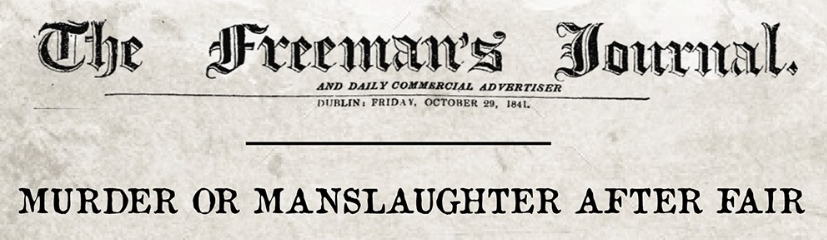
The Freeman’s Journal and Daily Commercial Advertiser
DUBLIN, FRIDAY, OCTOBER 29, 1841.
MURDER OR MANSLAUGHTER AFTER FAIR
Tuesday morning, the dead body of a farmer named William Power, of Shangan, near Butlerstown, in the Parish of Lisnakill, this county of Waterford, was found dead inside a hedge on the new Cork road, three miles from the city. His skull appeared to have been dreadfully beaten by sticks or other heavy weapons (not stones), as to have caused his death. There was a good deal of blood on the road, near where he was found, and he would appear to have bled profusely from the nostrils and mouth, but there was no incised wound discernible on him.
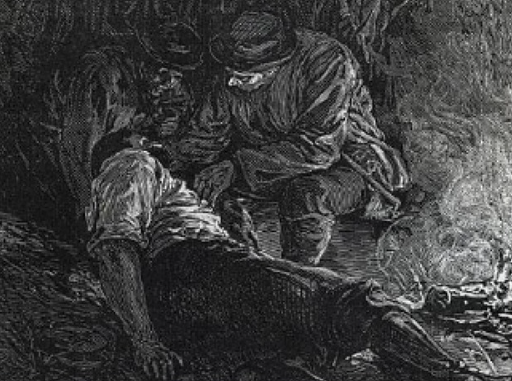
The deceased was at the fair of this city on Monday for the purpose of selling a cow; in this he did not succeed, and the cow returned home on Monday night. There were two hats found at daybreak at the door of the turnpike toll-house, nearly two miles beyond where the deceased was found. It appeared that some men were calling at the toll house, during the night, but the toll man did not get up to answer the call. It is surmised that the hats were left at the toll-house by those men. The hedge within which the deceased was found bore the traces of a struggle having taken place there, and the hands of the deceased bore similar marks.
Inspector Wright, of our City Constabulary, proceeded to the place immediately after the intelligence reached this City. The place where the body was found—within a mile of Shangan, the residence of the deceased—is a short distance outside the City Liberties. Mr. Wright accordingly procured the attendance of Thomas Gamble, Esq., the County Coroner, by whom an Inquest was held yesterday. We did not hear the result of the inquisition when our paper was put to press, but we have no doubt the verdict will be one of “Wilful murder,” stated the Waterford Chronicle.
Two men, Walter Wall and Richard Keane, were charged as above, having been arrested at Four-mile-Bridge, near Kilmeaden, on the Tuesday evening (October 26th). The Inquest was held in the deceased’s residence at 12 noon on the Wednesday. Inspector Decluseau of the Tramore Constabulary, and Inspector Wright, City Constabulary, were in attendance, and gave valuable assistance in the conducting of the investigation.
By the evidence recorded at length in the Waterford Mirror, it appeared that the deceased, who had drink taken, had a quarrel with the two accused, whom he met at the public house of Patrick Buggy, in Barrack Street. It appeared, on circumstantial evidence, that they followed him on his way home, and gave him the wounds of which he died. The Coroner recapitulated the evidence, and the Jury, after a short consultation, returned a verdict that the deceased came to his death from injuries inflicted on him by Keane and Wall. A committal was immediately made out for the pair, who were in custody in an adjoining apartment, and they were then transmitted to gaol under a Constabulary escort, to take their trial at the ensuing assizes.
The Kilkenny Journal and Leinster Commercial and Literary Advertiser concluded its report thus: “The deceased was a man of an exceedingly athletic frame, under thirty years of age. The prisoners are comparatively diminutive in frame, and also young men.”
The Waterford Chronicle reported: “We understand the unfortunate deceased and the two men charged with this serious offence had recently violated their solemn pledge of total abstinence from intoxicating liquors.”
*Many thanks to Philly Dunphy for verifying via the Griffiths Valuation maps that the turnpike toll-house in question was at Dooneen, where the old Kilmeaden Road met the then-new Cork Road.
Post Comment