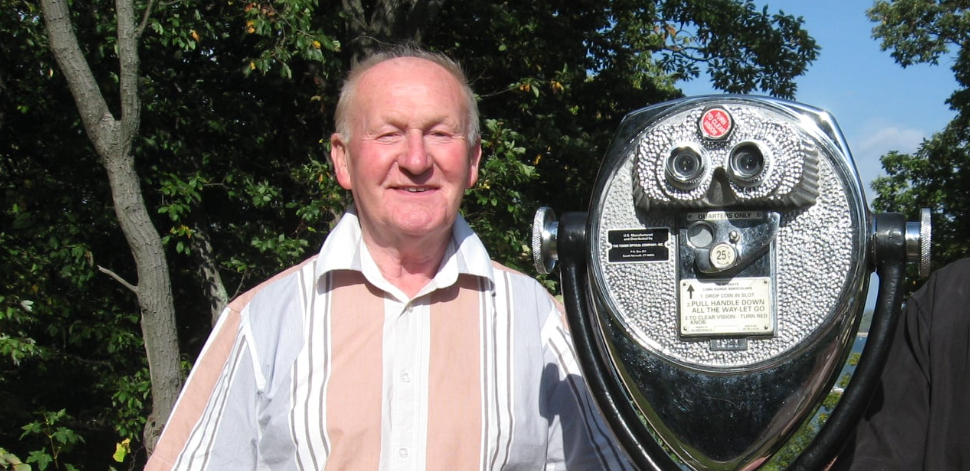
Sparianco spirit of playwright and author
Maurice Connolly’s writing revealed real rural life
The late Maurice Connolly — a native of Cullinagh, Kilmeaden, who died at his home in Foulksmills, Co Wexford on June 11th, 2019 — was a gifted author and playwright, whose work was sprung from the soil and soul of rural Ireland.
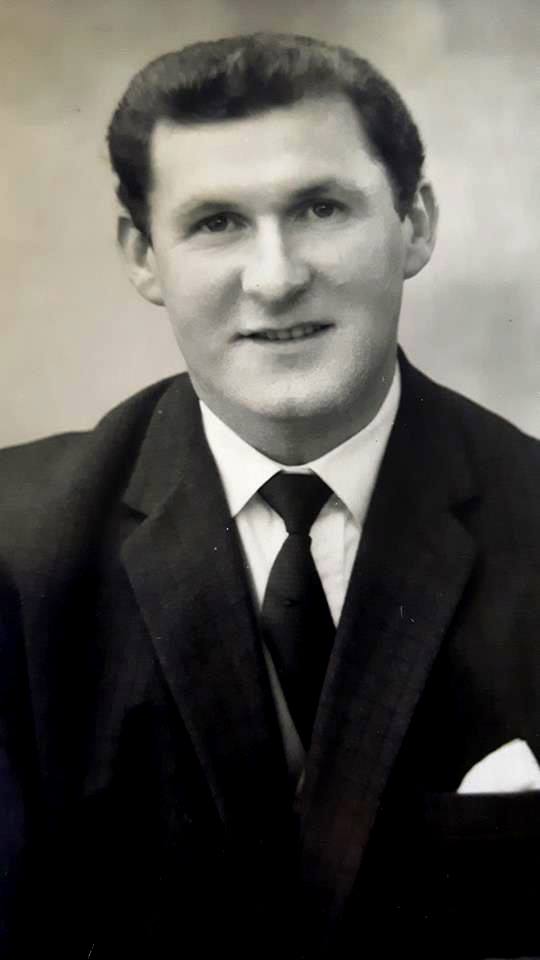
Born in 1938, Maurice lived a varied life and his capacity to absorb people’s traits and insecurities informed his rare ability as a storyteller. He spent most of his early life on the family farm in Kilmeaden, working with his older brother Michael.
When I last spoke to him in 2016, he said his childhood wasn’t easy, especially for his mother Mary. When Maurice was seven, his dad Jack, who came from Clonea originally and fought in the First World War, died in a Dublin hospital as the result of a blood clot. And so Mai sadly lived the next half-century of her life as a widow, running the farm with her two sons initially, and then just Michael.
“I’ve heard many stories about Jack Connolly’s dray cart being loaded down with bags of coal on the return journey from Kilmeaden Co-op for the residents of the Millstreet,” Maurice recalled. “Apparently a great deal of banter was indulged in with the air often turning slightly blue. After all, my father had been in the trenches for four years. However he didn’t get it all his own way. Both parties got a great deal of fun out of these encounters.
“In my early youth my father and our near neighbour Richard Gamble were the only suppliers to the Co-op. Both were early share-holders with the creamery. Gortaclode covered a larger area, but at the same time, the Lynch family would remain the only suppliers for a considerable time. The popular Ryan family then also became suppliers.” The year before his dad passed away, on the eve of the end of WWII, a disastrous barn fire fire in a destroyed a large harvest of oats and wheat; a severe loss at that time.
Educated in Ballyduff and De La Salle (and remembered by Kevin Walsh as an early playing member of Kilmacthomas FC), after finishing school in the mid-fifties, Maurice, like so many others, took the boat to find work, labouring in London. On his return a decade later, aged 27 (and prompted by an uninspired English production that made him think he could do better) he duly penned a provocative play entitled ‘Ebbtide’, set in a farmhouse overlooking a small fishing village.
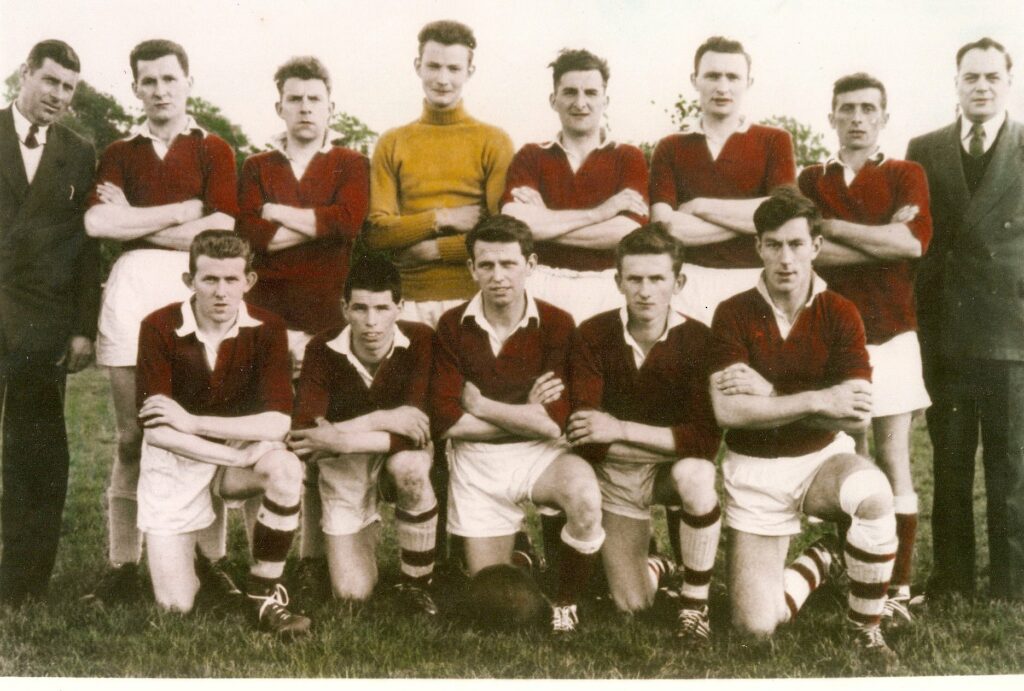
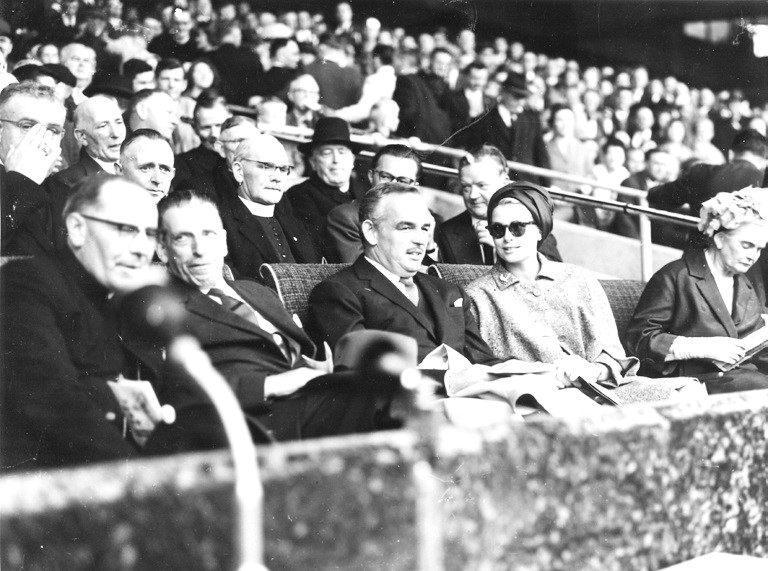
[Photo per Michael Faulkner; names courtesy of Linda Power]
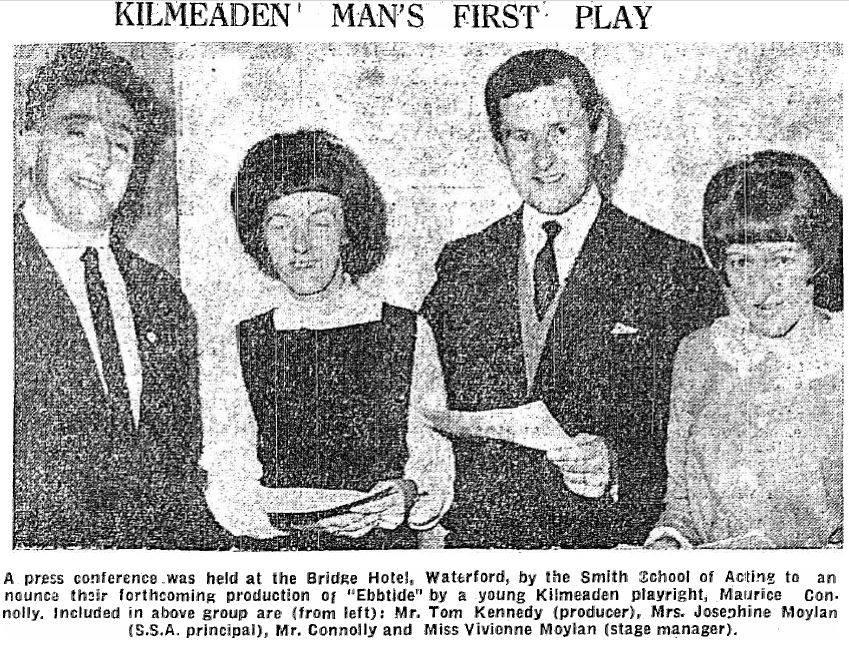
Having received the recommendation of no less than John B. Keane, who advised Maurice and producer Tom Kennedy, its opening run by “The Smiths” stage school at Waterford’s Muncipal Theatre (Royal) was a sell-out.
The Munster Express critic Elizabeth O’Connor described the ‘world premiere’ as “a pot-pourri of high drama, comedy and pathos,” whereas her News & Star equivalent was less charmed by its quota of controversy, language and profanity. Strictly for mature consumption, the play pulled few punches and its rawness and racy reviews drew intrigued audiences to venues around the country, including the Dublin and Cork Drama Festivals.
Though a bit disillusioned by the fuss it attracted, two years later Maurice followed up his debut with 1967’s ‘Weekend Appointment’, a thriller set in modern Dublin. It was widely performed and won an award at the Kerry Drama Festival in Killarney. The adjudicator, RTÉ’s Christopher Fitzsimon, said it was on a par with anything to be seen on the West End. Some may recall going to see it in less-lavish places like Kilrossanty into the mid-seventies.
Despite this enduring acclaim, for various reasons and tribulations, Maurice “switched off” his creativity for what proved to be a three-decade interlude; a decision he came to regret. In 1969 he bought a public house in Golden called ‘The Old Triangle’. He married Anne (Carroll-Walsh from Piltown) in 1970, and the couple’s son John was born during their “four blissful years” in Co Tipperary. They then moved back to Kilmeaden, where another boy, Thomas, “made his appearance”.
Maurice had a successful stint as an auctioneer (trading with Michael as Connolly & Connolly) from 1973–’77 before buying a farm at Dunanore, Foulksmills, Co Wexford. He happily spent the rest of his days at Goldentown House and in his retirement, which he greatly enjoyed with his children and grandchildren, Maurice rekindled his passion for writing.
In 1996, not long after removing his wellingtons, the text of a new Connolly play called ‘The Magic Maker’ — a blackly-comic take on religious strife, which he penned over three winter months — was released in bookshops, coupled with a revised version of the ‘Ebbtide’ script.
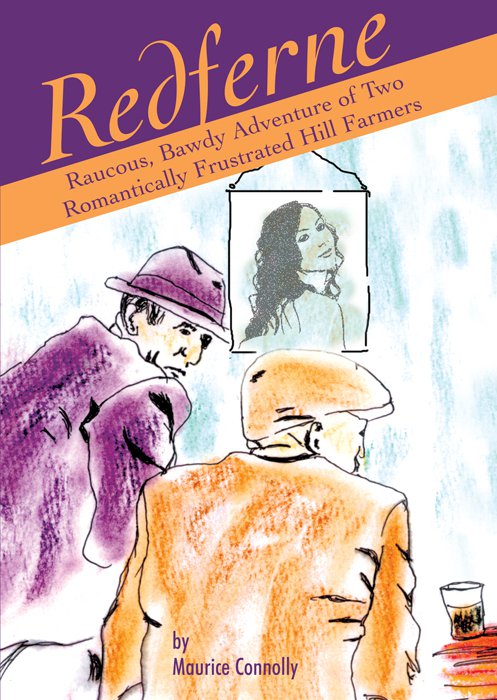
Nine years later he published ‘Redferne’, a remarkably realistic novel that told the sometimes humorous story of two frustrated hill farmers, frantically seeking two women to share their lonely, isolated lifestyle. It sold a not-insubstantial 1,300 copies.
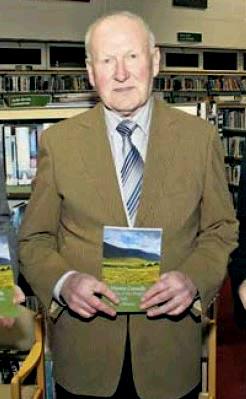
He published a further book in 2011 (right), namely ‘Tales of the Bright, the Dark & the Bizarre’, a superb compilation of short stories which, using true-to-life dialogue, intelligently and humorously cuts deep to the heart of bucolic Irish existence; with distinct echoes of his upbringing in post-war County Waterford. In 2013 he brought out ‘The Damned Generation (and Other Stories of Love, Sex and Violence)’.
After 31 years in Kilmeaden all-told, Maurice always retained an affinity with his roots, even down to his curious email address. “There’s a strip of land near Cullinagh which we always knew as ‘Sparianco’. However, very few people know it as such,” he told me.
A quietly but uniquely talented gentleman, Maurice left an enlightening literary legacy and lots of lovely and loving memories.
Top image: photo of Maurice courtesy of Mary Sue Connolly, who said of her uncle: “You walked through this world with such grace and compassion. With such a big heart and a gentle soul.”
Post Comment