Last voyage of Louis C. Lee
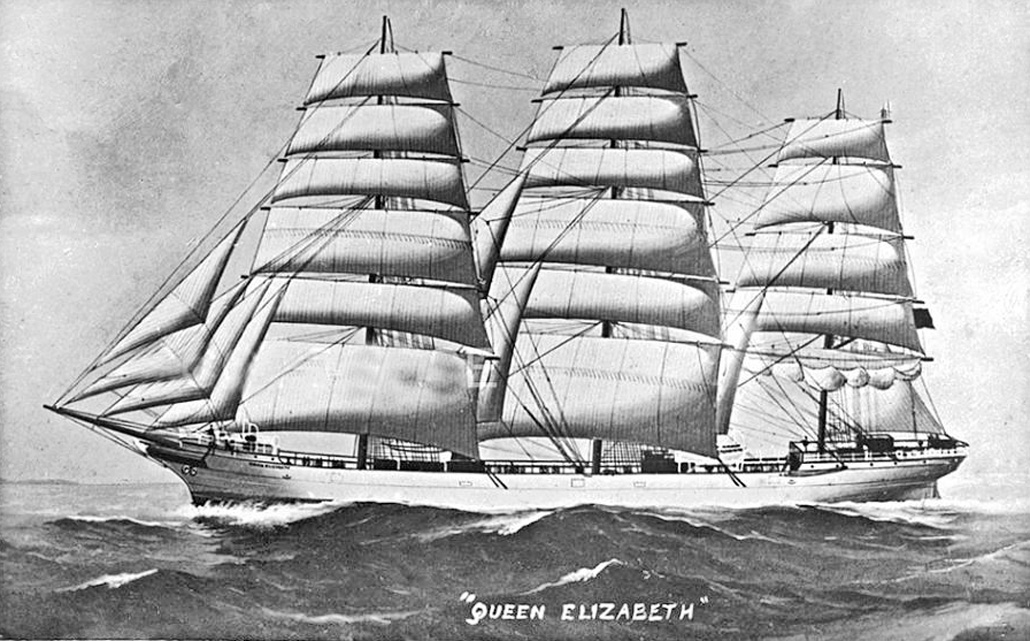
On New Year’s Day, 1897, the steel, full-rigged Glasgow cargo sailing ship “Queen Elizabeth” arrived at Waterford and berthed beside the Quay, just opposite the former Munster Express newspaper offices and printworks.
The 1,785-ton, three-masted British vessel had left San Francisco and braved the tempestuous seas of Cape Stiff with her consignment of wheat, bound for merchants on Suirside. Aboard the vessel was a 18-year-old apprentice, Louis Lee from Aberdeen.
Just out of his time, having joined the ship under indentures three years before, Louis was due to receive his officer’s uniform once they’d weathered the voyage via treacherous Cape Horn and the sunny tropics. Colleagues described him as a steady lad, and a promising sailor.
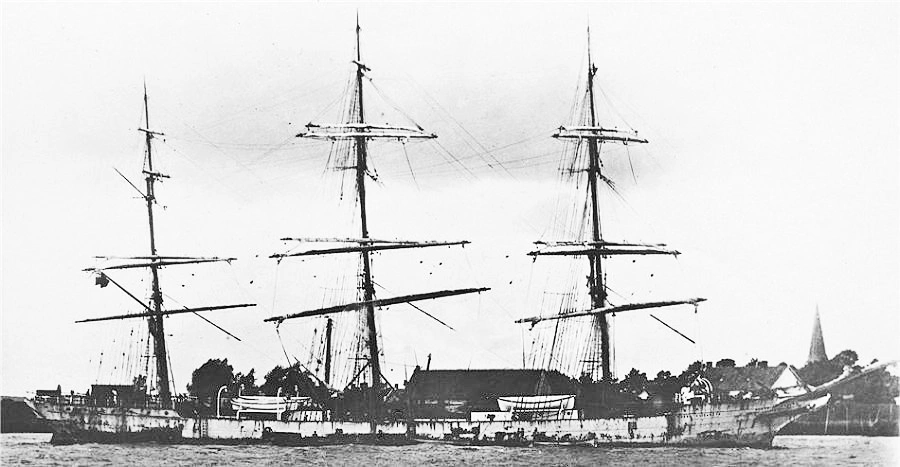
When Captain Pulton moored at Waterford, Louis’s learning curve was over. He would emerge as a fully-fledged officer when the ship re-sailed after a month in port, discharging its load of grain. However, he would be cruelly denied that sense of pride.
On the morning of Wednesday, February 3rd, Lee’s body was discovered drowned in a couple of feet of water just abreast his ship. In one of his hands were a few cigarettes and in the other a clutch of seaweed; indicating he’d made an attempt to drag himself to safety after evidently falling in.
That week’s Waterford News published an account of the Coronor’s Inquest held the next day before E.N. Power, with T. Power, O’Connell Street foreman of the 12-man jury. Captain Fulton, who identified the body, said he’d last seen the deceased at about 2 o’clock on Tuesday when he was on deck looking after empty sacks.
Second mate Robert McBurnie deposed that Louis was on duty all day Tuesday until work finished around 5pm. That was the last he saw of him. He missed him the next morning and at about 10am word came through. He saw Louis’s lifeless body lying a few yards from the Quay wall.
John Moore, an officer on the ship, said Louis and a fellow apprentice, Peter Cooper had gone ashore to purchase some boots. They returned to ask for (and were given) some extra money as they said they hadn’t enough. However, Cooper maintained he hadn’t seen Louis alive after five o’clock.
Constable Denis O’Keeffe said that on searching the deceased he had found 2 shillings, 6d. in money, a pipe, and the handful of cigarettes. The body being rigid, he considered him to have been dead for several hours. There were no marks to suggest he’d met a violent end.
Morgan Kavanagh, Quay and River Watchman, had been on duty from 5.30pm on the Tuesday to 5.45 the next morning, a mere 15 feet from where the fatality took place. He saw several people going to and from the ship, though not young Lee. There had been a heavy fog over the river on the night in question.
Local man Michael Walsh said he was the person who first spotted the body in not more than a foot of water and duly raised the alarm. Dr. Cutlar, Medical Officer, gave his opinion that death was accidental due to drowning.
The verdict strongly recommended to the Harbour Commissioners that they “do something to protect the river side of the Quay”. Indeed, the ship’s captain told the Coroner that nearly every port he had experience of had removable standards & chains at the water’s edge for people’s protection.
Making the local and national press, the tragedy evoked widespread sympathy in the city and large numbers of locals attended aboard the ship to see the teenager, laid out in the uniform he was destined never to wear as a qualified officer.
A request for a memorial was received by the Harbour Commissioners from Louis’s heartbroken parents. His father travelled from Scotland to take their son home to be buried rather than attending Navigation School, as intended. He was interred in Trinity Cemetery after a service in St Andrew’s Church on February 8th.
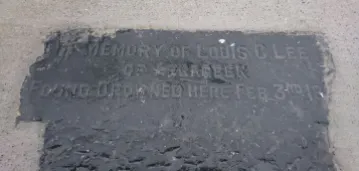
It was agreed to cut an inscription on the Quay wall in Waterford. The plaque, having been displaced or relocated, can be seen today embedded in the pavement behind the city’s bus station. Though now partially covered over, it reads:
“In memory of Louis C. Lee, found drowned here, 3rd February, 1897.”

Protective quay railings were duly erected in order to prevent a recurrence of such a misfortune. These were set in place in 1899 at the request of the Board of Trade.
Sixty years after the tragedy, an alternative theory emerged as to what transpired the night Louis died. An article by Thomas Drohan in The Munster Express suggested that Lee and a number of his crew-mates had crossed the Quay to a nearby tavern to toast the new officer. The revelry reportedly lasted well into the night.
It was said that, one by one, the shipmates retired to their bunks. Fatefully, Louis was the last to leave and in the darkness headed across to go to bed. He never made it on-board. In the pitch black, he missed the quay’s edge and plunged overside, his cries for help going unheard.
It was not the last tragedy to befall the ship on which he’d learned the ropes. On December 20th, 1915, the “Queen Elizabeth” left Liverpool for Santos, Brazil, with a cargo of coal. Last spoken to the next day, 3 miles southwest of Tuskar Rock, she was never heard from again, apparently sinking without trace.
A mystery to go with that of luckless officer-to-be, Louis C. Lee.
Post Comment