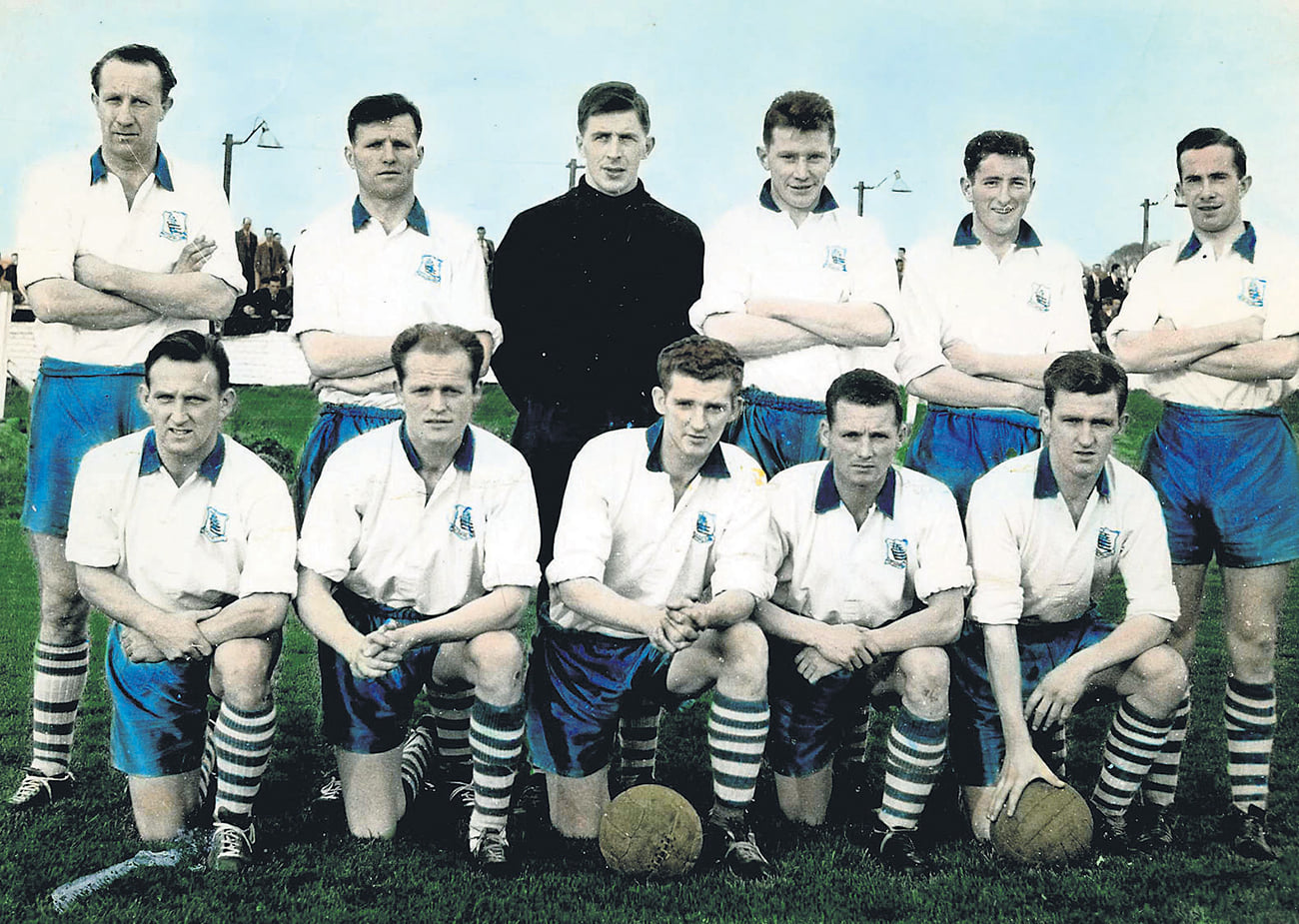
Jaunty Jack Hunt was a carefree talent
“I was stopped in my tracks… I read it in his eyes before he said it. Jack Hunt was dead… I was stunned.”
ALFIE HALE
He came from a family steeped in sport. His father, Martin, was a mainstay of Gaelic Games and athletics in Butlerstown. His uncle Jim up the road at Slieveroe was one of the greats of local GAA lore.
Destined to have a ball at his feet or in his hands, Jack Hunt grew up at Tramore Cross in the early thirties and forties with his sisters, May and Jo. His mother, Mary, was a member of the Morrissey family from nearby Ballyduff, several of whom had worked in the Stephenson woollen mills at Fairbrook, Kilmeaden.
Living just over the field from the Butlerstown club pitch at the time, Jack proved a natural when it came to hurling and football. He was invariably one of the first picks whenever games were organised in the local national school, and after the last bell.
In 1948 he suffered a badly broken leg just below the kneecap while playing for the Butlerstown juvenile footballers against Ballybricken at the Sportsfield. He fully recovered to later play minor and junior hurling for the county. That elusive “great bit of stuff” was in the genes.
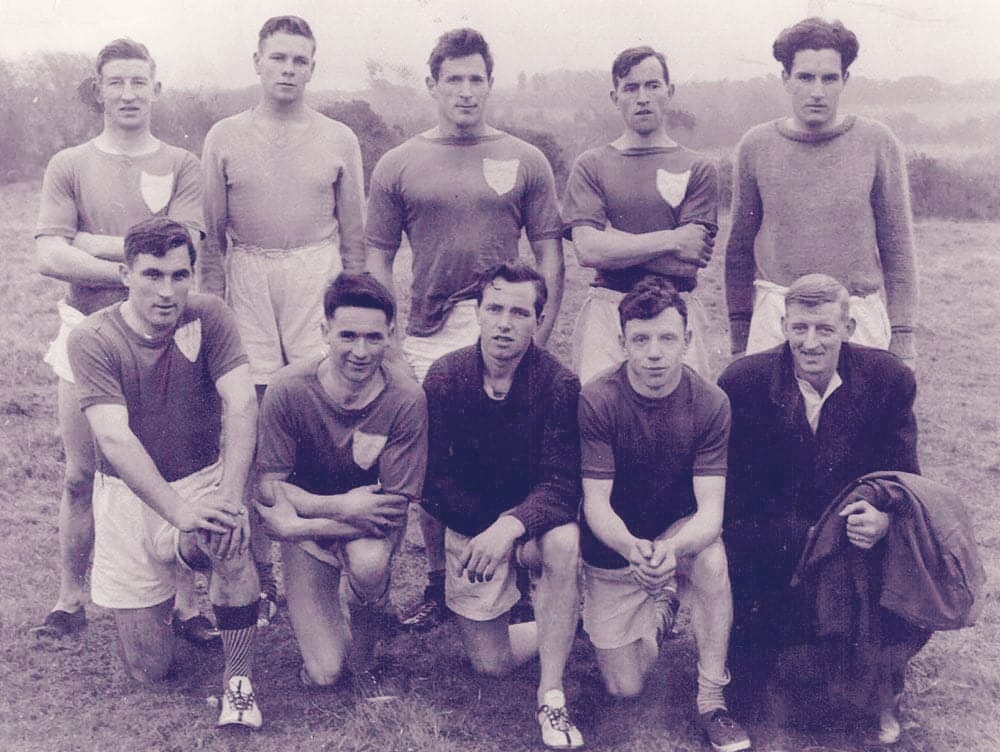
Strong and tenacious, with stamina to burn, Jack had also set out on a soaring soccer career that began with city clubs C.Y.M.S. (Catholic Young Men’s Society) and the original Evergreen United and ended with the latter’s Kilronan reincarnation. The brilliant Bawnfune boy won FAI and Munster Junior Cup medals with Evergreen in 1953.
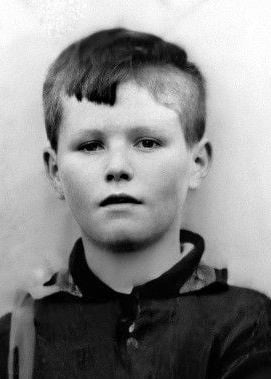
[Pakie O’Brien Collection]
Regarded as the best defender at junior league level, he signed for Waterford FC in November the following year. Under player-manager Stan McIlvenny (a Scot who had captained the USA to victory over England at the 1950 World Cup), Jack made his League of Ireland debut days later and quickly established himself as a tough-tackling and attacking right-full.
In 1955, a decade before the Blues’ big breakthrough, Waterford had a team of “all-round power and attraction” which Alfie Hale rated as “the unluckiest in the history of Irish football”; almost claiming a league and cup double but finishing empty handed.
Uncompromising but fun-loving, Jack proved popular among Kilcohan Park fans and in the dressing-room. When he married Helen Power from Morrissons Avenue in the autumn of ’56, team-mates and directors presented him with an eight-day chiming clock. He’d a job in the Iron Foundry in Bilberry at the time, as did his father. Life was good.
In a side backboned by the brilliant Fitzgerald brothers, Dixie Hale, and Con Martin, Jack, raiding down the flank, provided crosses and deadball deliveries for countless goals. That instinct also saw him operate up front on occasion, scoring and putting in a “scourging” display to beat Transport 4-0 in January 1958.
The Irish Press match report included a “humorous” incident where Jack pushed the referee out of the way whilst setting the ball for a free-kick. An innocent Waterford forward got the blame rather than the rascal responsible. They all laughed about it later.
But soon smiles were far from the soccer fraternity’s lips. Within a short few weeks, Hunt and his colleagues were standing in silence before an FAI Cup tie against the same opposition. They were paying their respects to the victims of the Munich air disaster and also five Donegal fishermen lost in a terrible trawler tragedy yards from Dunmore East pier just four days after the catastrophic Manchester United plane crash.
Nearly 18 months on, despite the Blues taking St Pats to a replay in the FAI Cup final (in front of a combined 45,000), Jack was surprisingly released in August ’59. Averse to the grind of training on the mudpiles that passed for practice grounds, he loved carefree days out like the Kilmeaden Sports, coming second in the long puck there the following month.
Whoever coined the phrase, All work and no play makes Jack a dull boy, might well have had a certain John Hunt in mind!
At a loose end, Jack was recommended to Third Division Swindon Town in England by ex-Waterford player, the infamous Jimmy Gauld. He took up the offer of a month’s trial, with the promise of a job as well as football wages, but didn’t end up staying long across the water. Though he’d yet to play for the first team, Swindon wanted to keep him and gave him time to make up his mind. But Jack decided home was where his heart was.
He returned to Suirside and immediately signed for Tycor Athletic, where he was a tower of strength in the right-half/full positions, helping them to back-to-back Munster Senior League championships, and adding long-range goals to his game.
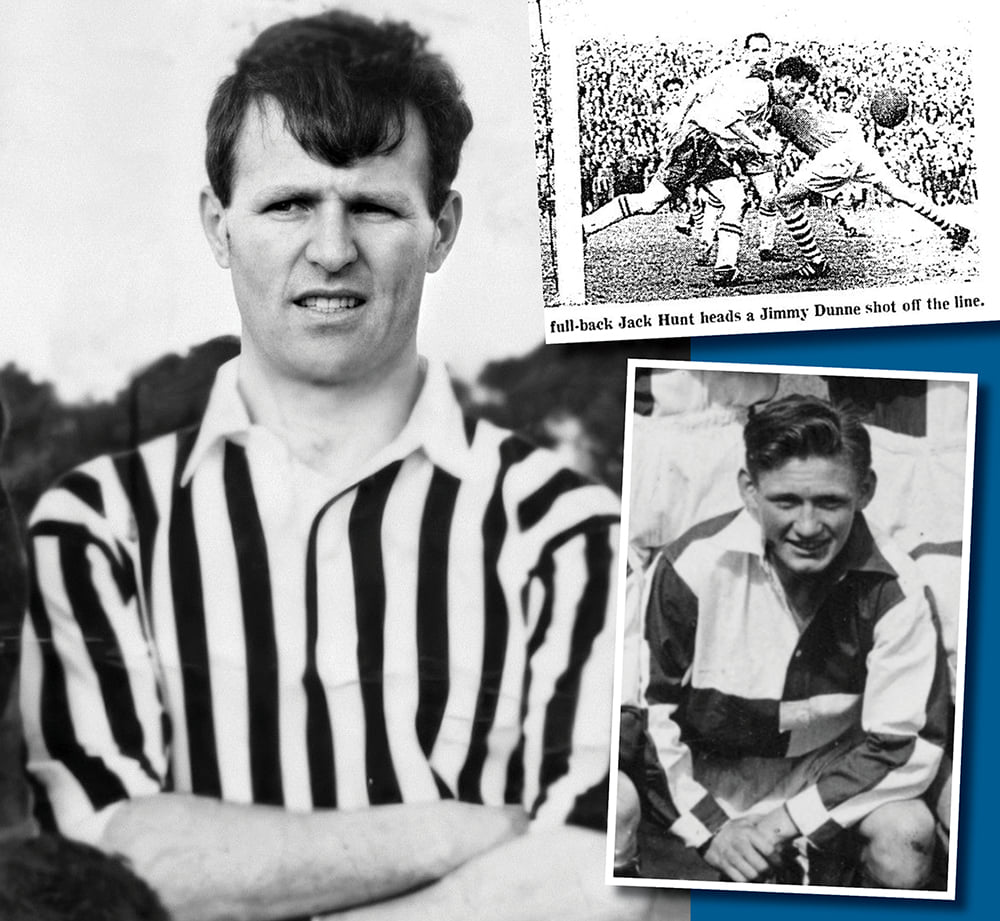
However, to the surprise of many, not long into the ’61-62 season he and an exodus of others requested their release and regraded to junior. Jack joined Lower Yellow Road outfit Maryville and indicated he was effectively retired from serious soccer.
But, having been trying his hand at rugby, before the year was out he’d been tempted by Limerick senior leaguers and regular giantkillers Pike Rovers, where he stood out a mile. Returning from Shannonside at the end of the season, he was on the verge of re-signing for Tycor but hooked up with Glenville instead.
That gave him the chance to fulfil an ambition to hurl with county senior champions Erins Own (like his famous uncle Jim before him), playing in the forward line of a illustrious XV, and also for the club’s junior footballers. Mixing it with the likes of the Mount Sion “All Stars”, he showed his “exceptional ability” with the camán in hand.
Yet, still only 30, such was Jack’s form on the junior league soccer field that he was even attracting the interest of the Blues once more. But that chapter, he decided, was closed. He linked up with Villa instead and then moved to Crusaders.
After an entirely new Evergreen FC was formed in Butlerstown by Paddy Halley, Tom (Luke) Power and Larry Power, Jack didn’t think twice about throwing in his lot with them. “I called the club Evergreen because I admired Jack Hunt and Walter Gough [of Kilronan] who used to play for the original Evergreen side… They were brilliant players,” Paddy recalled in a short-lived newspaper I had, Tramore Hinterland, in 2012.
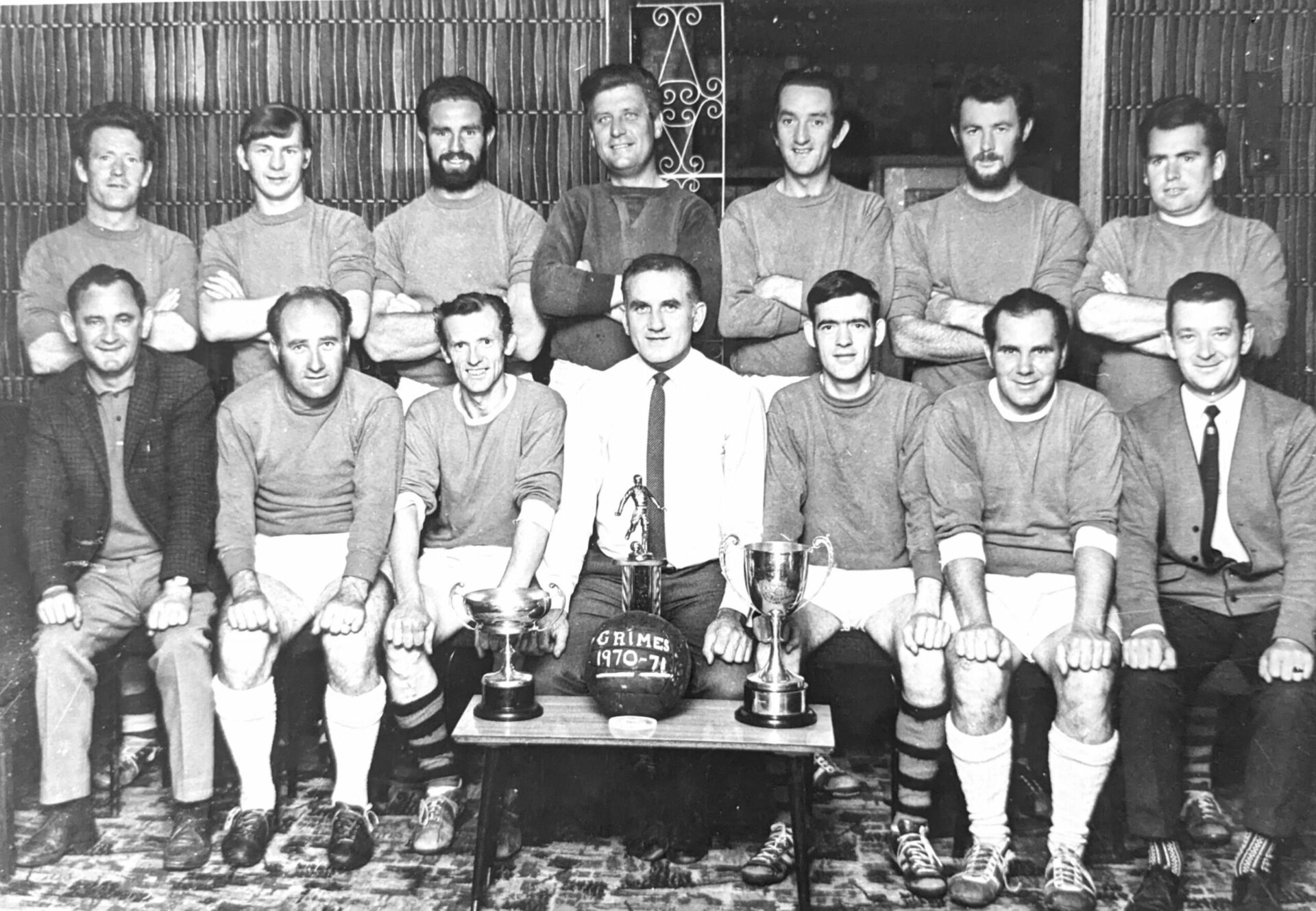
As captain and centre-back, Jack led the Kilronan Park outfit to the area final of the Munster Junior Cup that first season in 1965-’66. He also stood out in the Pubs League for teams like Caulfields, which was near his home in the Glen (just across from Jim Storan’s barbershop), and fielded in the Factory League for the Builders, being an employee of McInerneys.
Sadly, it was partly through that occupation that Jack met his tragic death, aged just 38, following a drowning accident in the summer of 1970. Working as a labourer on the hotel’s new wing, he and a pal went for a midnight swim in the pool of the Majestic in Tramore where, poignantly, his wedding reception had been held there 14 years before; the cake decorated in blue and white.
Alfie Hale recalled hearing the awful news from a SVdP collector as he made his way into Sunday mass the next morning. In his popular Waterford News & Star column, he wrote: “I was stopped in my tracks… I read it in his eyes before he said it. Jack Hunt was dead… I was stunned.
“Jack was so strong, so full of life, it couldn’t be true. But it was, and never again will we see this tough character stamp his authority on a soccer match in Ozier Park, a card game in Bob Graces, or a hurling match in his native Butlerstown”.
Hunt, he said, “had many friends, his funeral was evidence of that.” The requiem mass in the Cathedral was attended by hundreds, as was the burial in Ballyduff cemetery, with GAA President Pat Fanning among the mourners, as were Jack’s father and mother, who would pass away in 1974 and ’79 respectively.
“The people who knew him well will tell you of his wonderful hurling ability that earned him a place in Waterford’s junior hurling team, an FAI Junior Cup medal with Evergreen (Duffy’s Team) and many more with Waterford Football Club,” Alfie noted.
“It was with the ‘Blues’ that I really got to know Jack. He was the regular right-back while I was a member of the panel that waited patiently for an opportunity… and, ironically, it was through Jack that I accidentally arrived on the scene.”
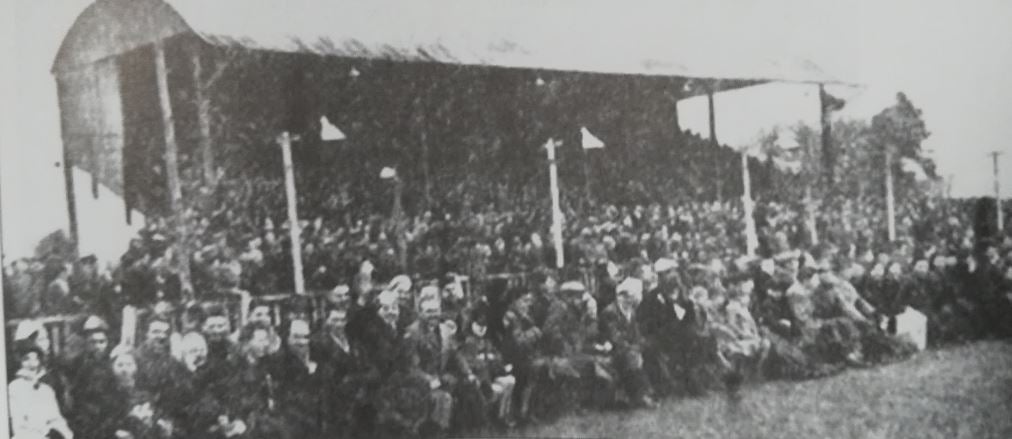
[Image from ‘Singing the Blues’ by Brian Kennedy, 2006]
He recalled a vital Shield game in “the big smoke” in 1956 against St Pats when, having been brought along as 12th man “for the ride” (there were no subs at the time) Jack took ill beforehand and 17-year-old Alfie got his chance earlier than expected.
He took it. Waterford won 7-1 and a star was born. Given “great encouragement from Hunt and company,” Alfie said he and Jack, who’d immediately returned to the team, became firm friends.“Those who didn’t know him well, usually misunderstood him, but he was, deep down, a man who enjoyed life to the full, and was impatient with those who didn’t.
“At soccer he could have become a great full-back. He possessed great strength and balance. His kicking of a dead ball with either foot was beautiful to watch, and was something I not seen surpassed in my days in English and Irish football.
“Though slow on the turn, his tackling was so strong and well-timed, few wingers ever bettered him, including his great opponent [Rovers’] Liam Touhy.
“But,” Alfie acknowledged, “the dedication wasn’t born in him. He refused to take life too seriously. Not for Jack the regular training, winter and summer, though he was one who enjoyed his football more than most. In fact he had up to the week before he died he’d played a big part in organising Bob Graces team for the Pubs league, which he planned on playing in.
“He was always out for a bit of fun and didn’t have much time for pessimists. Life was too short to be cautious was his motto, and tragically it proved all too short for Jack. So he died as he lived ‘having a bit of crack’… Waterford and its sporting public will miss the rugged, handsome boy from Butlerstown.”
Waterford held a benefit game for his widow and children against Shamrock Rovers a few weeks later. Arranged by player/boss Alfie and a few others, Rovers immediately agreed to play and didn’t look for expenses. Sir Matt Busby sent over signed memorabilia from Old Trafford for an auction.
That Munich tribute at Kilcohan had come full circle.
In front of a big home crowd, the Blues and the Hoops shared eight goals — an inspired Hale netting all of Waterford’s in the second half, three of them late on, to haul back a 4-0 deficit.
Having given him his start back in the fifties, he might have felt he owed Jack Hunt a fitting send-off. And what a tribute Alfie paid him, both in the paper and on the pitch.
Post Comment