Brothers in arms: siblings killed in The Great War
BEHIND the cold, calamitous statistics of the First World War lie captivating stories of personal sacrifice which have been largely erased from contemporary history.
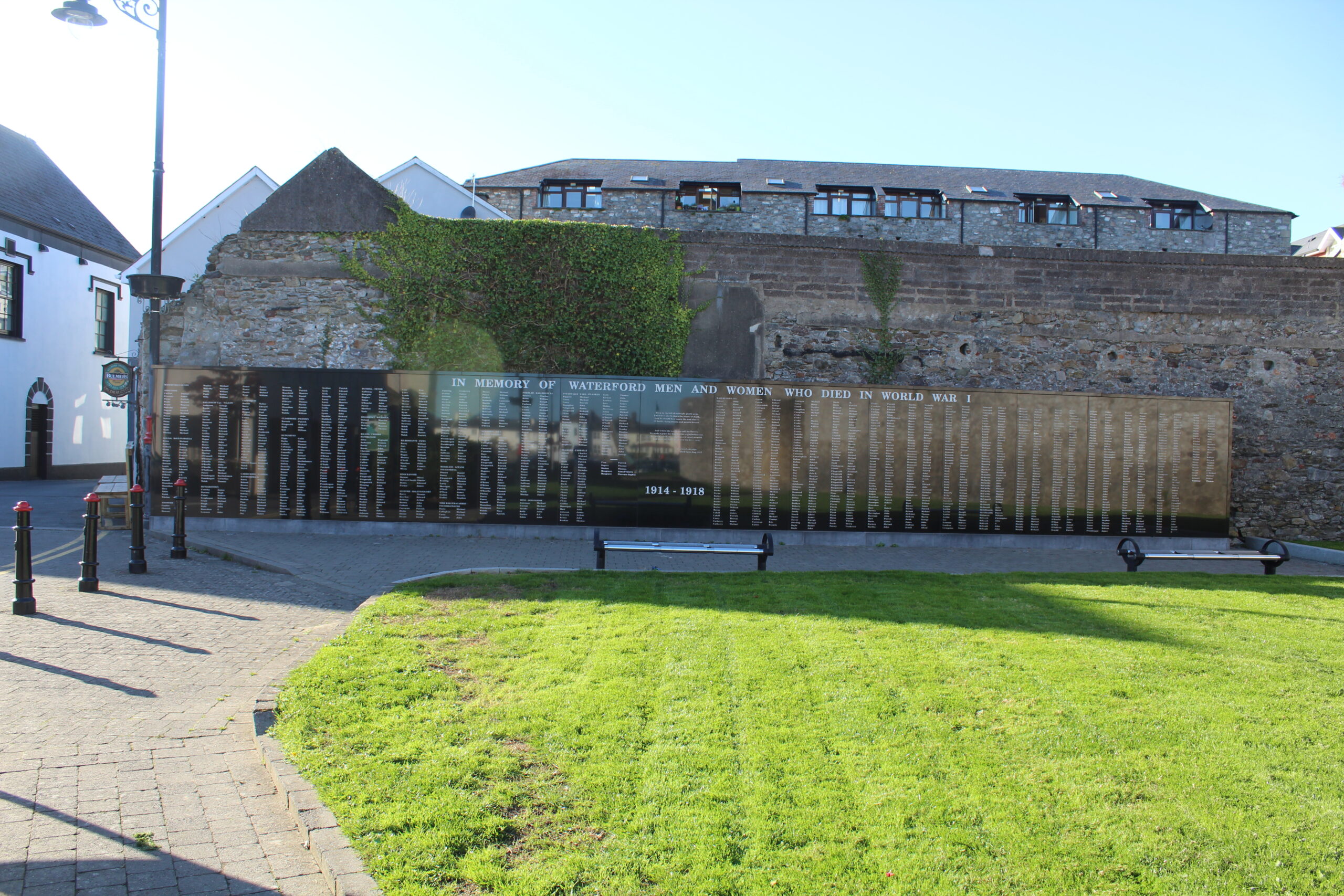
The Waterford Memorial in Dungarvan is a monument to the approximately 1,100 people from the city and county who lost their lives during The Great War. Many of those killed in action, in posts all over the world, have no known grave.
The Royal Irish Regiment’s main recruiting grounds here were in the neighbouring south-east counties of Waterford, Tipperary, Kilkenny and Wexford, with mostly young men answering the call.
Once such volunteer was Michael Whelan from Dungarvan, the younger of two siblings. Their experiences are recounted in Neil Richardson’s excellent collection of veterans’ stories, ‘A Coward If I Return, A Hero If I Fall: Stories of Irishmen in WWI’ (The O’Brien Press, 2010).
As Richardson tells it, Whelan’s brother Thomas, who served in Gallipoli, Turkey, and the Western Front, was a pre-war regular and artillery gunner. He was discharged when his leg was blown off in April, 1918.
Michael, a diminutive farm labourer, took up the mantle, applying to be a stoker. This involved shovelling coal into the enormous boiler furnaces that powered the Royal Navy’s battleships – a hellish job.
Neglecting to mention he was only 15 years of age, Michael was sent to sea to train but was dispatched to the Royal Naval Hospital in an exhausted state after just a few weeks. No wonder: he’d contracted the measles; then developed pneumonia.
Realising his tender years, doctors sent Michael home to Waterford. But, undeterred, on turning 18, he enlisted – legally – in September 1918, just before the war ended, this time as a seaman. He continued his naval career after hostilities ceased, sailing around the world.
During WWII he was on board the famous HMS Warspite, manning his station in the Bombardment of Tripoli. In 1945, 27 years after entering the Royal Navy proper, he was discharged, suffering from pulmonary tuberculosis, and returned to his native Dungarvan. He finally succumbed to TB six years later, aged just 51.
Valiant in vain
Then there were the Grey brothers from Barrack Street in Tallow. Private Eddie Grey joined the 1st Irish Guards at the end of 1912, aged 18.
When war commenced in the summer of 1914, Eddie, a former farm hand, was sent from Wellington Barracks to Mons and found himself retreating to France the next day under severe German duress. Despite endless, foot-blistering marching and a few ill-fated rearguard actions, the jaded, starving, sun-scorched troops somehow managed to push the Germans back at the Battle of the Marne.
Yet, amid the fog of confusion that enveloped much of the war, at one point in the ongoing exchanges Eddie’s column accidentally came under attack from allied artillery. Though he survived that close call, on September 12, his luck ran out. Aged 22, Eddie was killed in action near Courcelles, Belgium; the exact cause unclear. His body was never found.
Back in Tallow his family received a telegram that Eddie was merely missing. Hoping he might be alive, his brother William enlisted at Youghal in May 1916, requesting a posting with the 1st Irish Guards. Two days before Christmas he arrived at the Somme, to freezing conditions. After being involved in forcing the enemy to withdraw to the Hindenburg Line in early 1917, William was redirected to Belgium to prepare for the Third Battle of Ypres.
That July, amid heavy fire, he was hit on the right arm by a lump of shell and was shipped back to Britain for surgery. A length of bone had to be removed along with the shrapnel and so in July 1918 he was discharged – still none the wiser about his brother’s fate. This ate away at William (later known as the Tallow postman) and he was tormented by shellshock until the day he died.
If you were fortunate to make it home from the warzone, you were never the same.
Hands of fate
Waterford family members came all the way from the Southern Hemisphere to fight for the allied cause. Little Michael Finn and his younger brother Patrick, originally from Ballyduff Upper, enlisted in 1917. Patrick had emigrated to New Zealand four years earlier, and worked as a timber-mill hand. During training he refused to do the norm and make out a will, reckoning it would bode badly.
After a winter stationed in Liverpool, he arrived in France on Valentine’s Day, 1914. A little under four months later, under a terrifying bombardment of the Kiwi contingent, a shell exploded beside Patrick. Bleeding heavily from his wounds, he collapsed and subsequently died, aged 26. He is buried in Sailly-au-Bois Military Cemetery.
A mere three months later, Michael, now 27 – having also gone to New Zealand, where he found work on a farm – was on active service in France. He was sent there in 1917, fighting in the final flurries of the Third Battle of Ypres. The depths of European winter inflicted ill health and after periods in hospital, Michael returned to the front line.
In an uncanny resemblance of what happened to his brother, in the autumn of 1918 a gas shell landed near Michael and the noxious fumes overpowered his already debilitated breathing. He collapsed and was evacuated to hospital in England, but thankfully survived to tell the tale.
Post Comment