Choirboy Soldier
Son of Kilmeaden Postmistress buried in Ypres
From a well-known Kilmeaden Church of Ireland family, Second Lieutenant John Haigh was killed in action on the Western Front on October 2nd, 1918.
Before joining the Royal Dublin Fusiliers regiment (3rd Battalion), John worked as a clerk at the Henry Denny & Sons bacon factory at Penrose Lane, Waterford, and was assistant organist in Christ Church Cathedral.
Small and slight, he and his friend George Jones, another Dennys clerk, both left on the Fishguard steamer in late-January 1915, only a week after enlisting. A number of friends assembled at Waterford train station prior to their departure on the Rosslare express to wish them good luck.
The pair joined the Sportsmen’s Battalion and John witnessed plenty of armed conflict before withdrawing to England to receive medical treatment.
On returning to France he applied for a commission, requesting infantry duty, and was duly attached to the Royal Irish Rifles (1st Battalion). He served through many further engagements with the enemy and trained up in Newmarket during 1917 before being reposted overseas the following April.
Having been wounded on September 11, John was killed in action exactly three weeks later. Aged 28, he was the only son of popular Kilmeaden postmistress Mary Jane Haigh and her late husband, Joseph.
Originally from Bradford, Joe came to Kilmeaden in 1880, and was employed as a manager of the Stephenson Brothers woollen business at Fairbrook for many years before taking up the sub-postmaster franchise in Kilmeaden.
In 1890 he had married Cork-born Mary Jane, who was a member of the Moore family from Stradbally and later Carriganure.
They set up home at Ballyduff East and a baby boy was born that same year.
Johnny was educated at Bishop Foy’s Protestant all-ages secondary boarding school at Grantstown, a noted sports academy, and the Mall. (Later, from the start of the Free State era, the school started teaching Irish, encouraged by the Marquis of Waterford.)
Listed on the Bishop Foy School Memorial in the Church of Ireland Cathedral, Henrietta Street, young Haigh would be one of 20 “Old Foyonians” to lose their lives in the so-called Great War.
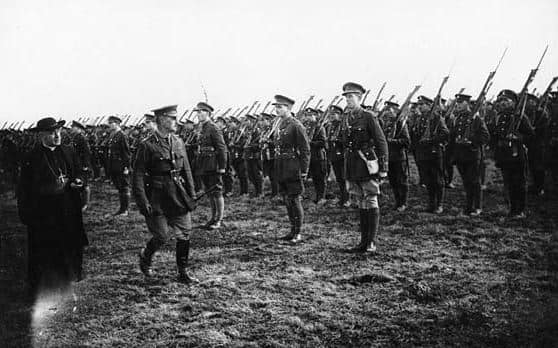
About 4,800 Waterford people (mostly men in their 20s) enlisted in response to an extensive and intensive recruitment campaign. An estimated 1,600 members of the Royal Irish Rifles died during 1918 alone.
John’s mother received a dreaded telegram from the War Office — marked simply “Mrs Haigh” — confirming he’d been killed in action. Her son also left behind a wife, Elsie (Johnson), in Greenwich, London. They were married just a matter of months.
Memorial services were held in Kilmeaden and Killotteran Churches where John had also been an organist for 14 years before volunteering.
When she herself passed away in 1933, aged 68, Mary Haigh’s funeral was one of the largest seen in the area, with Lady Susan Dawnay playing the organ at the service. (Lady Irene Congreve did likewise when Joe died, aged 65, in October 1911.)
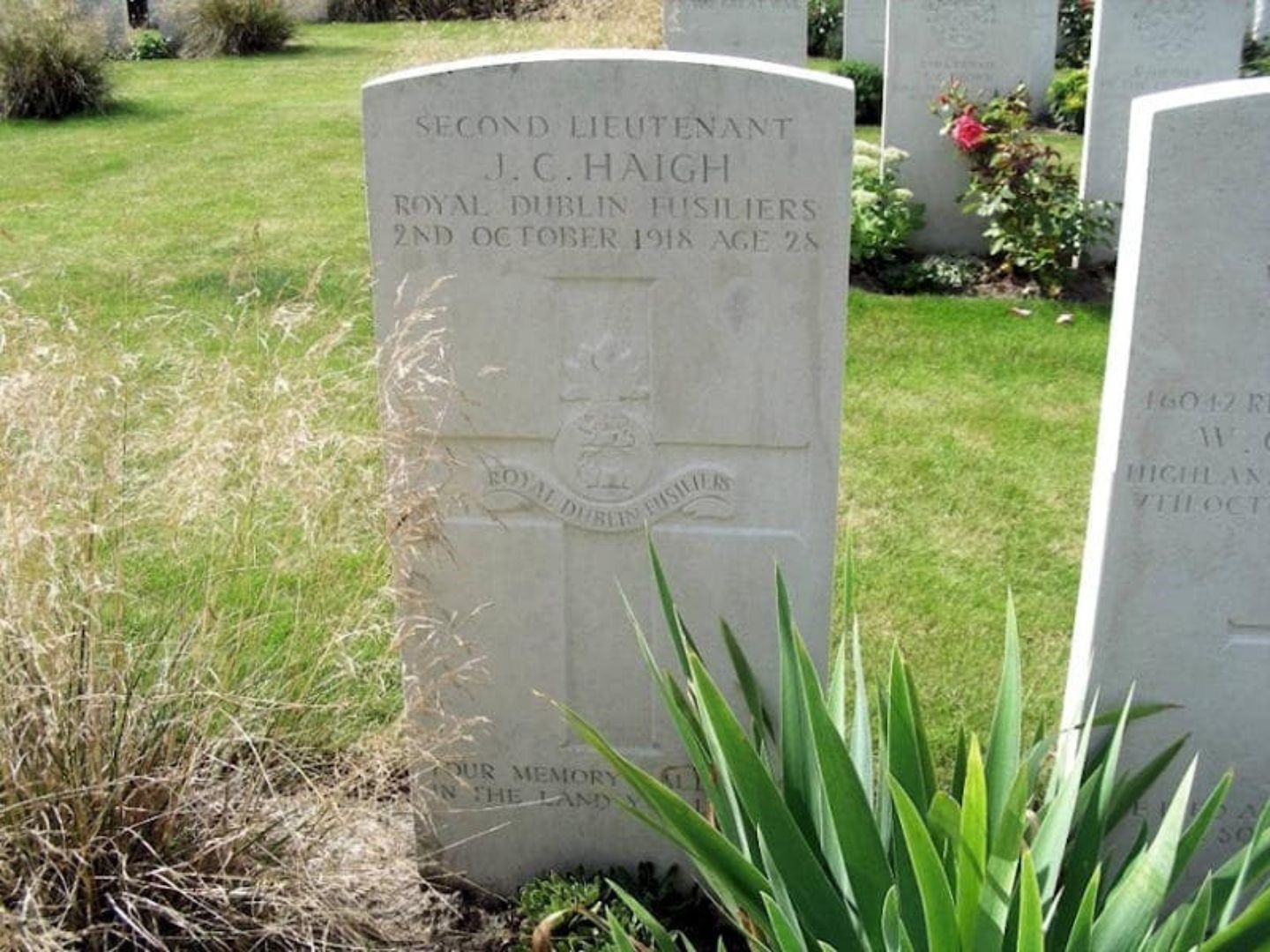
John’s official grave site (identifier VB1) is located in the Dadizeele New British Cemetery near Ypres, Belgium, where he drew his last breath. It appears his body was exhumed and moved there from an original burial place close-by.
The village where he was re-laid to rest had been in German hands for much of the First World War until it was taken by the allies three days before John was killed.
Originally from Bradford, Joe came to Kilmeaden in 1880, and was employed as a manager of the Stephenson Brothers woolen business at Fairbrook for many years before taking up the sub-postmaster franchise in Kilmeaden.
Top image: John Haigh’s headstone in Dadizeele New British Cemetery, Moorslede, West-Vlaanderen, Belgium. Photo: waterfordsdead.shaunmcguire.co.uk
Post Comment