Green-fingered Paddy graced many fields of Oates
Back when the buccaneering Blues of Waterford ruled League of Ireland soccer, the man responsible for one of the finest playing surfaces in the country was Ballyduff man Paddy Oates.
Paddy grew up in Knockaderry, though the family previously lived at Amberhill. From Tipperary originally, his father John Oates worked in Kilmeaden as a bakery foreman and was married to Joanie (Johannah). Their son Patrick was born on St Patrick’s Day 1902.
The youngest, and last-surviving, of eight children, Paddy had five brothers, namely James, Simon, John, Tom, and Andy, and two sisters, Ellen and Bridget. Many of them became well known in the spheres of sport and culture.
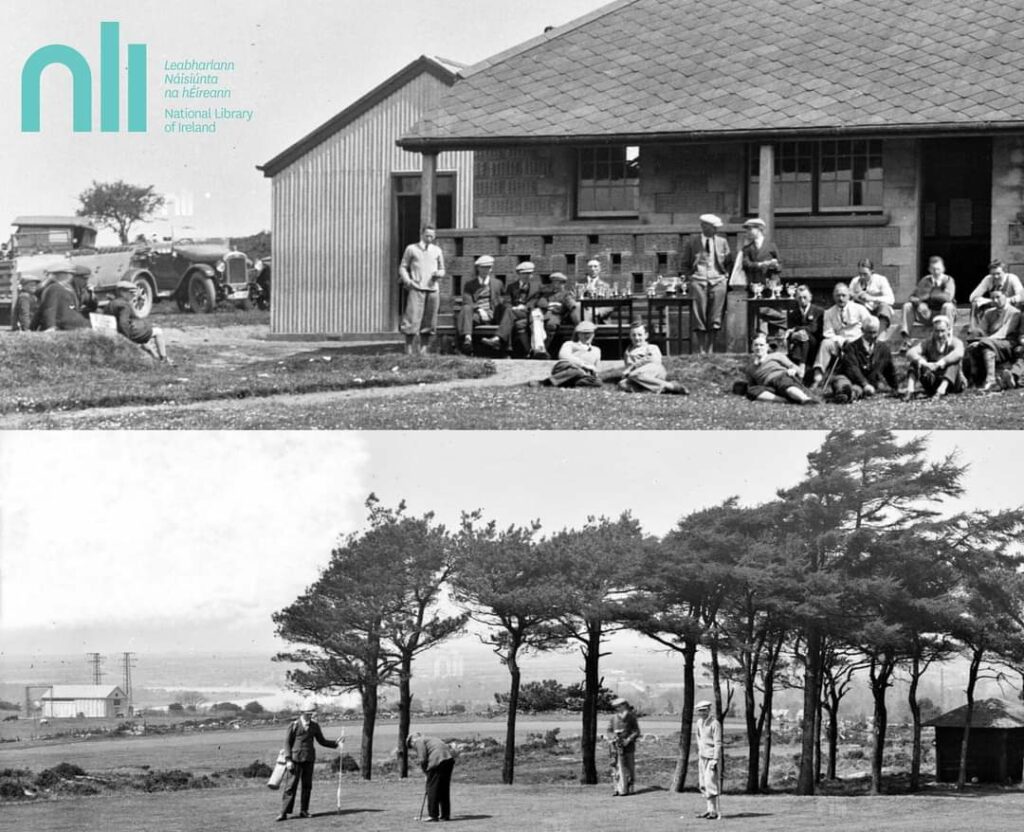
Having gone to school in Ballyduff, a teenage Paddy got a job as a greenkeeper at Waterford Golf Club and little did he know how long it would last. He would spend the next thirty years manicuring the greens and fairways at Mount Misery, cycling to work at dawn to get the course in order.
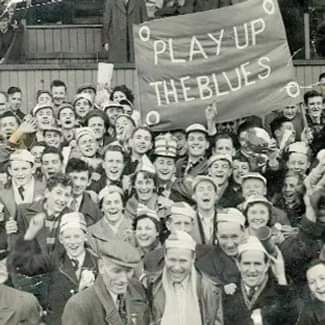
He then took up employment with builders Alex Stubbs and Co. on the nursery side of the business before, in the late fifties, turning his hands to the upkeep of football pitches. After three seasons looking after the Junior League’s headquarters at Ozier Park, he took up the position of groundsman at Kilcohan in the summer of 1962.
His decade-long stint at Waterford FC coincided with the glory days of Hale, Matthews, Tommo and Johnno et al — an era which yielded a succession of titles from 1966.
In the wettest of winters, Paddy worked miracles in ensuring the often-muddied ‘dog track’ was in pristine condition for the next home fixture. As soon as the weather improved, he would have it like a billiard table.
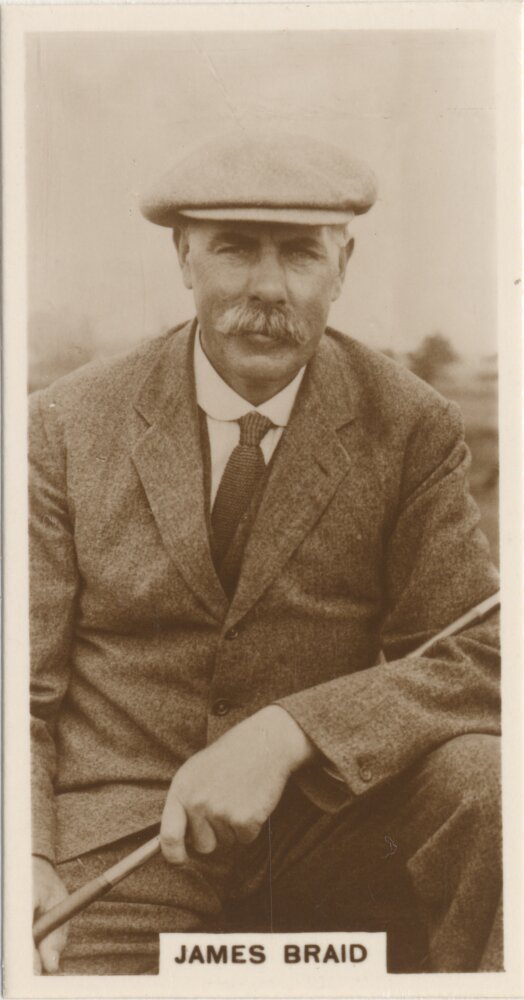
He credited much of his knowledge to James Braid, a Scottish farmer who won the Open championship five times before becoming a course architect. He was engaged to design and supervise the extension of the original Waterford golf course at Newrath to 18 holes in 1934. Willie Park Jr, a two-time Open winner himself, did the front nine in 1912.
James Braid
Hero
Notable Courses
Badge
Carnoustie (Championship)
Year of Birth
1870
Year of Death
1950 aged 80
Place of Birth
Earlsferry, Fife, Scotland
Biography
James Braid was born in 1870 to James Braid (a farm worker) and his wife Mary (née Harris) who was an accomplished weaver. His father had two other children from an earlier marriage of which he had been widowed. James came into the world at Liberty Place, between Earlsferry and Elie, but the family later moved to a small weaver’s cottage at 36 High Street, Earlsferry.
His cousin Charles Smith, the foreman clubmaker at the Army and Navy Stores in London had notified Braid of a vacancy that had arisen. So, although Braid had never made a club in his life and knew nothing about the process, he set off for the Big Smoke with at least an understanding of how to work with wood and tools.
From late 1893 until the summer of 1896, Braid’s time away from his London day job saw him practice at a number of clubs, including Chiswick, Sudbrook Park and Mid-Surrey. He also assisted at Hastings in 1895 before becoming the fulltime professional at Romford a year later.
Braid laid out the course at nearby Theydon Bois in 1898, receiving £4.13s.6d for his efforts. It was a 9-hole affair (which Fred W. Hawtree extended to eighteen holes in 1971), most of which is still intact. It would be the first of many courses he’d design but his professional playing career was also in full swing.
Three years after winning his first Open in 1901, Braid moved to Walton Heath and he would remain Head Professional there until his death forty-six years later. The club’s two courses are the work of Herbert Fowler and the canny Scotsman knew better than to tinker with layouts generally accepted as being among the best in the British Isles.
Instead, he concentrated on winning the Open again and by the end of the decade, he would be crowned Champion Golfer of the Year and hold aloft the Claret Jug a further four times; twice at St Andrews in 1905 and 1910, at Muirfield (again) in 1906 and at Prestwick in 1908.
Braid had a remarkable playing record in The Open, entering every championship between 1896 and 1938. All told, he took part in 39 events (38 consecutively) with an astonishing nineteen Top 10 finishes.
His record in the News of the World match play was also very impressive, competing in 32 consecutive tournaments from 1903 to 1939 (winning four times and finishing runner-up twice).
It’s reckoned that Braid played more than 1800 rounds of 18-hole golf during his playing career in matches, tournaments and qualifying events and his record stands up well against the other two members of the Great Triumvirate – versus Harry Vardon it’s 55 won, 12 drawn, 49 lost and against J.H. Taylor it’s 41 won, 11 drawn, 36 lost.
Braid’s contract at Walton Heath allowed him to be away from the club for up to ninety days during a year so, when he was not competing in tournaments, he was able to travel the length and breadth of the country designing new courses or modifying and advising on existing layouts.
During his career, it’s reckoned Braid designed more than a hundred 9-hole and 18-hole courses. He also extended more than fifty 9-holers to 18-hole layouts and he either reconstructed or altered over two hundred courses in some way or another, even if just advising on new bunker schemes.
Braid rarely travelled abroad – he was apparently affected badly by motion sickness – so his foreign designs are limited to around a dozen in total in N. Ireland, the Republic of Ireland and the Isle of Man. He ventured occasionally to play on the continent of Europe, winning the French Open at La Boulie in 1910.
Braid used Paisley contractor John R. Stutt for construction work on at least fifty of his projects over a time span of more than quarter of a century and it was his trusted friend Stutt who completed his last course at Stranraer in Dumfries and Galloway, shortly after he died in 1950.
In the book James Braid and his Four Hundred Golf Courses, authors John F. Moreton and Iain Cumming had this to say in their epilogue: “Braid’s courses seem to stand the test of time better than most… [his] work will never become obsolete: it has actually become ‘required reading’ for today’s trainee architects who, it is to be hoped, will remember the values which Braid established.”
Concluding an essay entitled ‘The design work of James Braid in Ireland’ in the book Golf Architecture: A Worldwide Perspective (Volume Six), Kevin Kenny wrote: “When summing up Braid’s work in Ireland, two things stand out: firstly, the simple but effective practice of adding trees and bunkers to provide definition to the courses under his care; and, secondly, and of greatest significance, the efficient and distinctly non-fussy manner in which he went about his work.”
After retiring from his duties with the Blues, Paddy Oates assisted clubs such as Southend United and Crusaders in a similar capacity.
His wife Margaret, whom he lived with at Summerhill Terrace in the city for many years, died in 1974. He had four step-children: Mary, Paudie, Peggy and Eileen.
Paddy put his knowledge of grass to further good use in retirement. Always a keen walker and a talented pitch & putt player, he chipped in with the Tramore club at Westown in the early seventies, and this kept him happily occupied for the rest of his days.
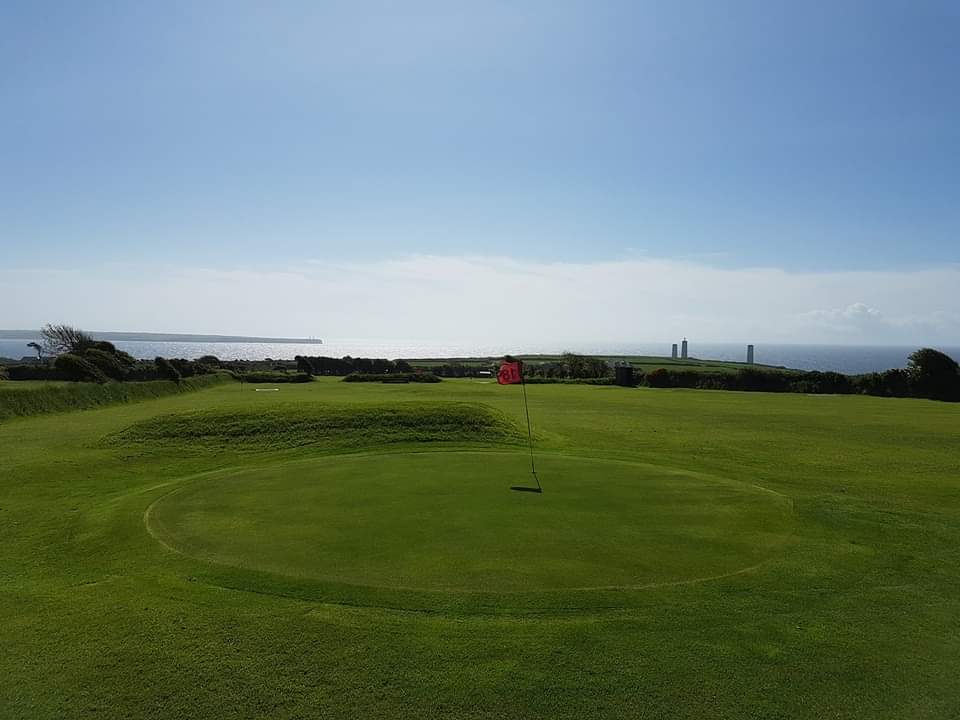
He went on to win an array of trophies (and turkeys) all around the country, and single-handedly created six new tee spots on the picturesque little course beside the Metal Man.
A household name in short-game circles, forty years ago Paddy received a silver tankard from the county committee for his services to P&P in Waterford. Despite failing eyesight, he was still playing (off eight) at the age of 86 a month before he died in December, 1988. Only a short time earlier he’d been a guest of Waterford Mayor, Ald. Davy Daniels, at City Hall in recognition of his longevity and legacy.
Paddy surely lived a full life. He was a member of the Old IRA and always followed the fortunes of local GAA teams. He liked playing cards, reading books, and going to the cinema. A lifelong pioneer, he attended mass daily.
If the sod was to rest softly on anyone, Paddy was well placed.
Post Comment