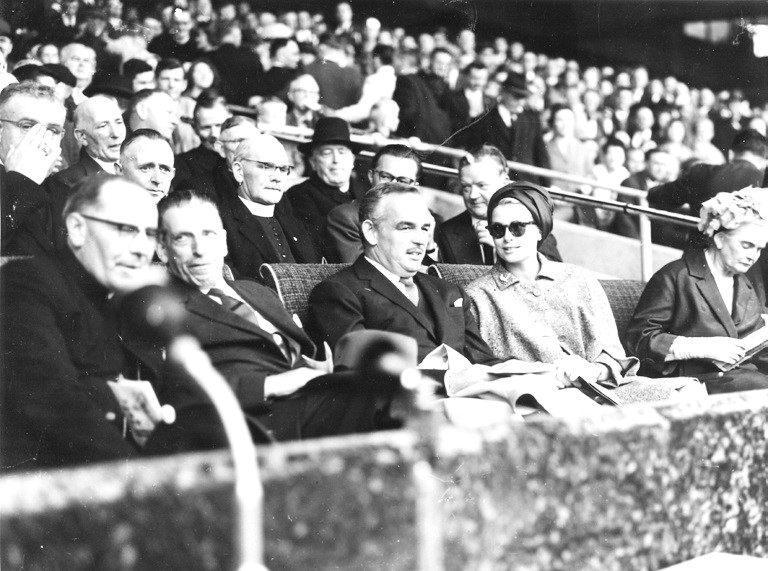
Golden Grace centre stage in Croke Park
Philly’s Princess of Monaco who called Clew Bay home
TAOISIGH were not normally upstaged on All-Ireland Final Day. And certainly not senior clergy in an era when their grip on Irish society was such that it was they who threw in the ball to start proceedings after receiving a kiss on the ring from the kneeling team captains.
However, there was no denying who all eyes were on when Prince Rainier and Princess Grace of Monaco sat among the 73,123 attendance at an absorbing hurling decider between local rivals Waterford and Kilkenny in Croke Park on September 1, 1963.
Pictured above in the Hogan Stand with Head of Government Seán Lemass and his wife Kathleen (far right) and the all-important Archbishop of Cashel and Ossory, Thomas Morris (left), the Grimaldis were spending a three-week holiday in Ireland, staying at the 1,000-acre Carton House, Maynooth, with their two children.
Unsurprisingly, the appearance of the royal couple — who lived in the fabulous Monaco Palace situated on the Côte d’Azur, high above the shimmering Mediterranean Sea — was front-page news the following day.
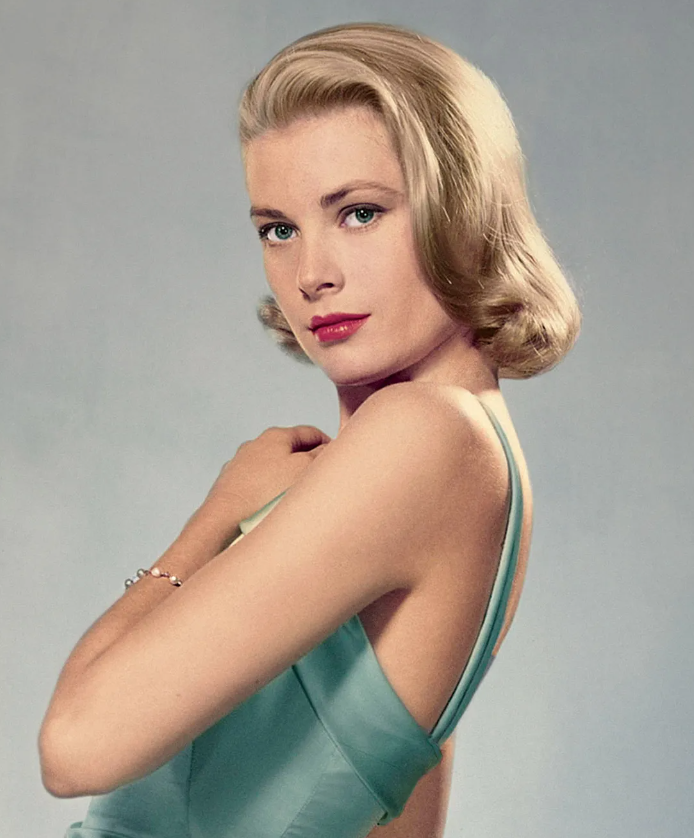
“Fast, almost too exciting … it’s marvellous,” Her Serene Highness told reporters on seeing the all-southeast spectacle, in which Eddie Keher scored no fewer than fourteen points as the Cats thwarted the Decies’ comeback (winning 4-17 to 6-8) and claimed their 15th title.
During the half-time interval. the “wonderful” Artane Boys Band played “Off to Philadelphia in the Morning”, a nod to Grace’s homeplace in the East Falls area. She wowed as ever in a grey tweed suit and navy-blue hat and waved to the crowd as she came and went.
An iconic actress from the “Golden Age of Hollywood”, Grace’s bricklayer grandfather, Jack, a native of Newport, Co. Mayo, had been an Irish emigrant to Philly and built the family’s fortune in construction. His son, John B. Kelly, won three Olympic gold medals for sculling. During WWII, he was appointed National Director of Physical Fitness by President Roosevelt and married a German athletics coach, Margaret. (Grace’s son and future heir to the Monegasque Throne, Albert, would compete in Bobsledding in five Winter Olympics.)
One of four children, Grace was born into affluence, and Catholicism, in 1929. Though her parents initially disapproved, after private school she pursued her ambitions to become an actress, while her striking natural looks ensured lots of lucrative modeling work. A star was ascending.
After a couple of low-key years and minor enough roles, she made her big-screen breakthrough alongside Gary Cooper in the classic 1952 Western, High Noon, which garnered four Academy Awards. None of those statuettes went Grace’s way, however, and she redoubled her determination to join the acting elite. Golden Globe and Academy Award nominations duly followed for her romantic duet with Clark Gable in Mogambo, with the Gone with the Wind actor reputed to have been one of several leading men Kelly was romantically involved with off-camera.
In the mid-fifties, proper critical acclaim arrived. After appearances in Alfred Hitchcock’s Dial M for Murder and Rear Window (the latter with James Stewart), in 1954 she won the Best Actress Oscar for played Bing Crosby’s long-suffering wife in The Country Girl, pipping Judy Garland for her performance in A Star Is Born. Grace’s final Hitchcock film was To Catch a Thief with Cary Grant, who years later named her as his all-time favourite actress above Ingrid Bergman, saying “She had serenity.”
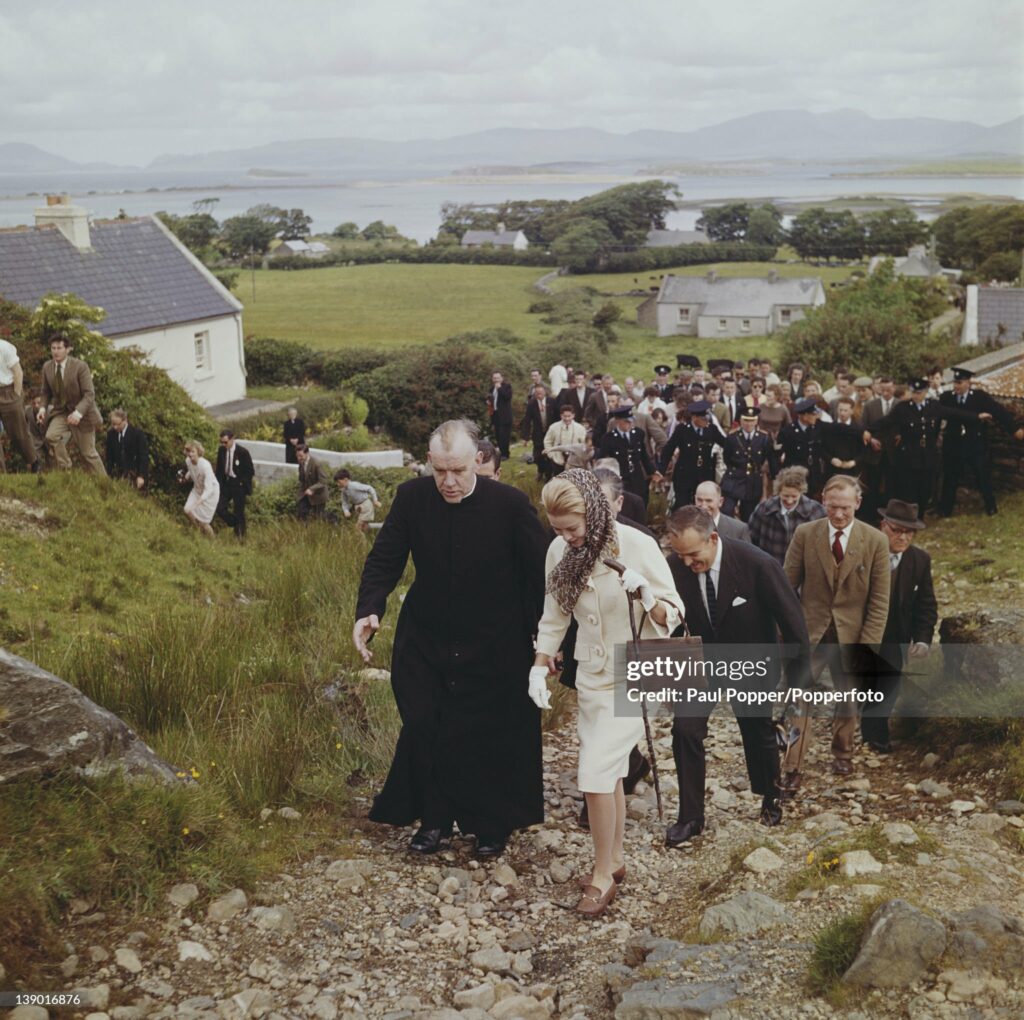
After portraying a princess (Alexandra) alongside Alec Guinness in The Swan, Grace’s last of eleven movie roles was in the 1956 musical High Society, a re-make of The Philadelphia Story opposite Crosby and Frank Sinatra.
With her fresh-faced looks and demure style, she was also a bona fide fashion icon by now; a legacy that would outlive her to this day, though in her last ever interview, the Princess admitted to disliking the “movie star” lifestyle. It was openly hinted, including in her coy acceptance speech to the Academy, that she was ready to quit a business whose seedy side was never far beneath the surface. Others claimed, however, that this totem of blonde ambition had been a willing and beneficial participant as she climbed the Hollywood ladder.
Decades on, Grace’s evident longing to make a comeback was about to be realised before a cruel twist of fate intervened. Yet the circumstances of her initial departure from Tinseltown had been the stuff of modern fairytales. Having ‘graced’ the New Year cover of TIME magazine, the celebrated “Miss Kelly” (aka the Girl in White Gloves) had headed the U.S. delegation at the Cannes Film Festival in April, 1955. While there, she was invited to participate in a photo session with Prince Rainier III, whose reign began in 1949. The seeds of an unlikely love were sewn and he wooed her with poetic letters mailed across the ocean.
After a year-long courtship, during which Rainier sailed to America and proposed over Christmas, they married on April 19, 1956, reputedly after she had paid an astonishing $2 million dowry; half from her own savings and the rest out of her potential inheritance.
An estimated television audience of over 30 million viewers watched the “Wedding of the Century” ceremony, though continental nobility, who frowned upon someone of “non-lineage” entering their social realm, were notable by their absence. Still, Grace looked every inch the film star in her ivory gown made of silk taffeta and lace, with the newly weds touring the streets of Monte Carlo in an open-top car.
Apparently genuinely smitten, Grace, 26, immediately gave up acting to marry the chain-smoking Rainier, conspicuously seven years her senior, and start a family. They would have three children: Princess Caroline was born 1957 and Prince Albert the following year. Princess Stéphanie completed the family in 1965.
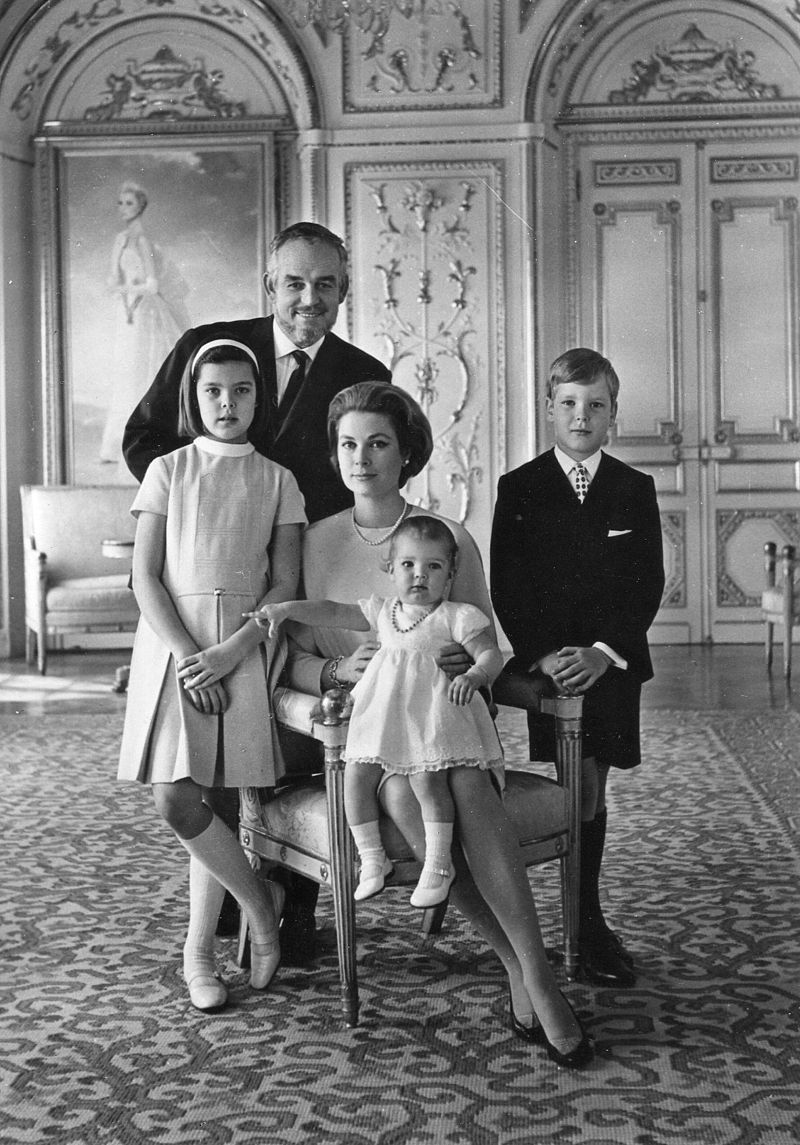
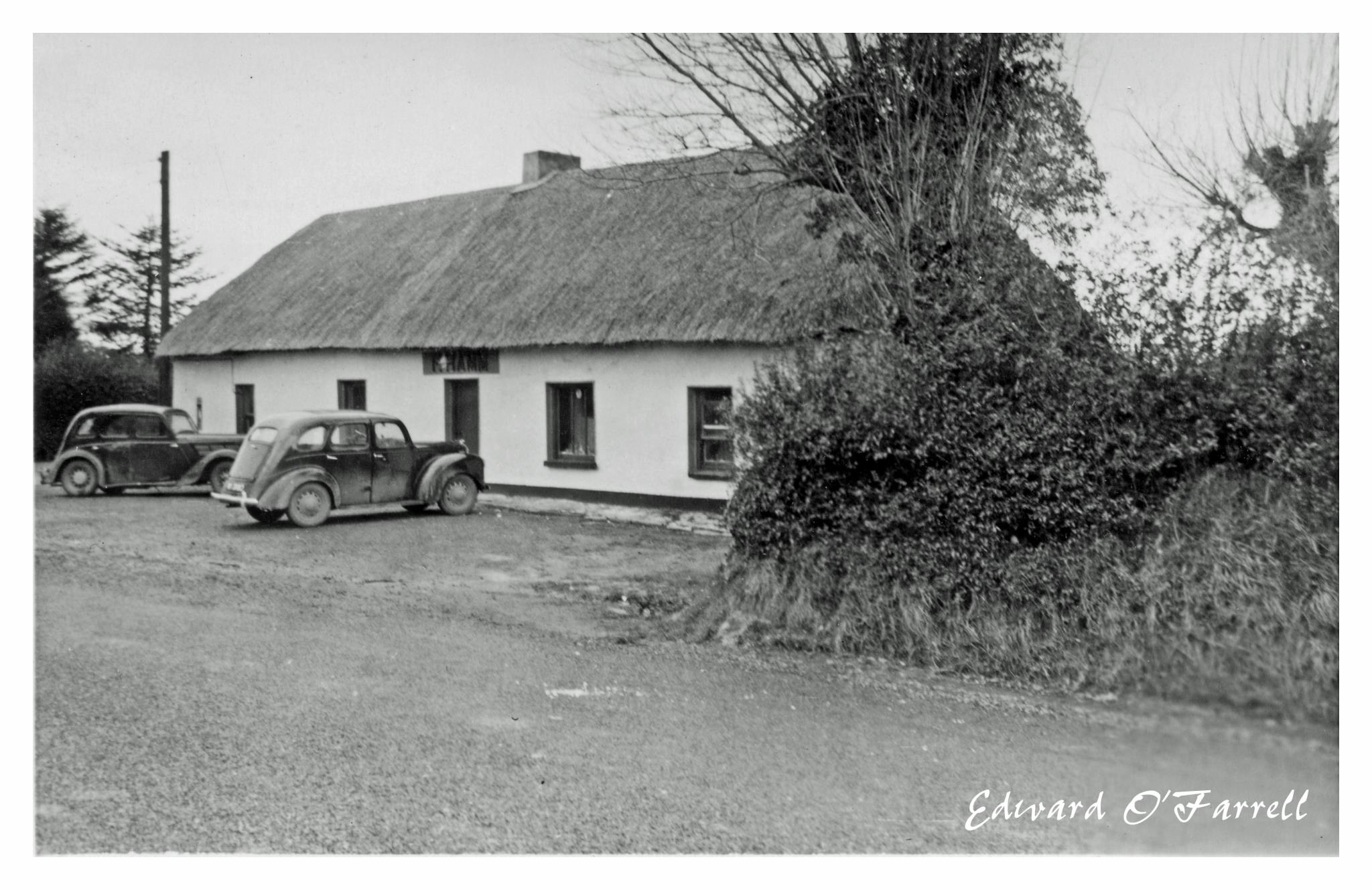
Also busying herself with multiple philanthropic pursuits, many of which remain active today, the Princess was second only to her friend Jacqueline Kennedy (whose future husband Aristotle Onassis was a good pal and business associate of Rainier’s) in terms of the world’s most famous women at the time of this, her second of several trips to Ireland during the sixties and seventies. She had first visited in 1961, taking in the opening of the Dublin Film & Arts Festival (staged in Croke Park due to a theatre strike) and would purchase the Kelly ancestral homestead, a small, tumbledown whitewashed cottage in Drimulra, in 1976.
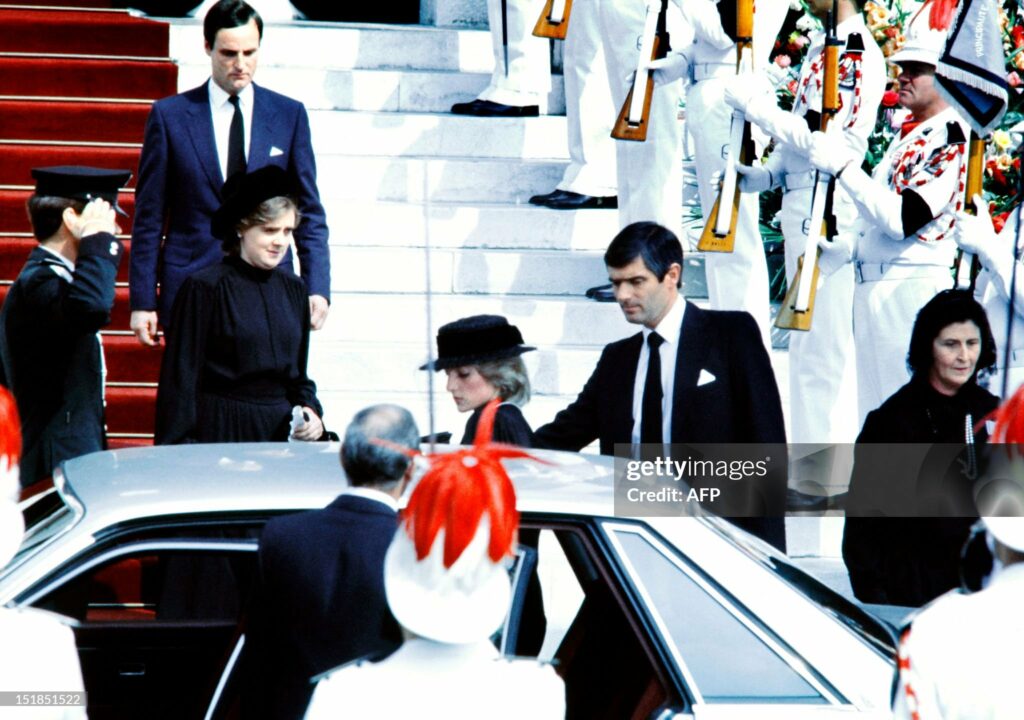
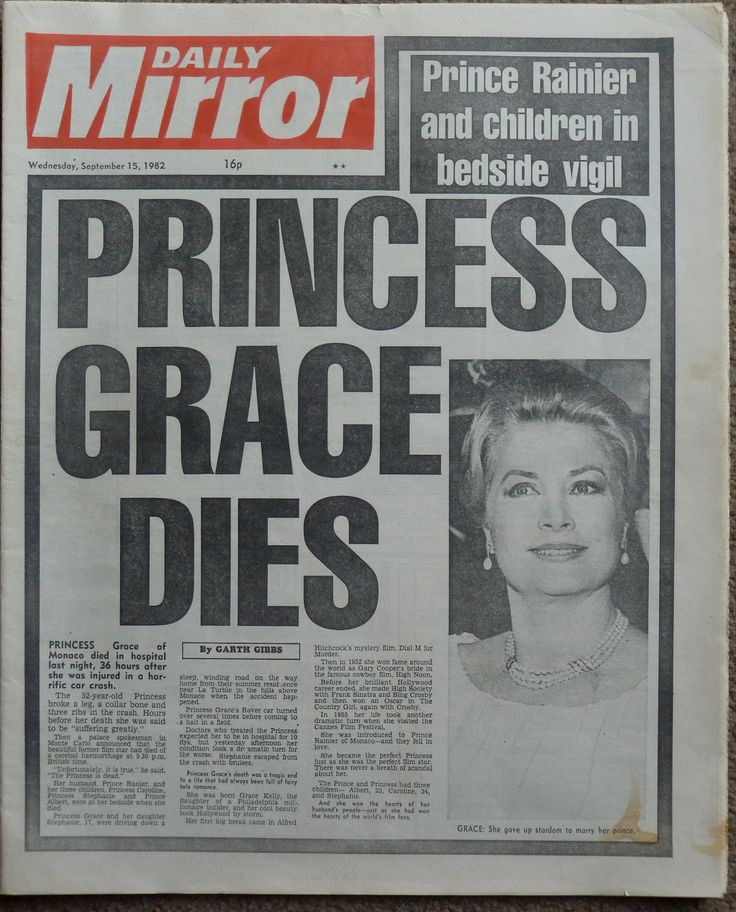
Plans to build a holiday villa there and spend more of her twilight years on these shores never came to pass. Tragically, Grace died in September, 1982, when, seemingly after suffering a mild stroke, she lost control of her Rover car (with Stéphanie, 17, in the passenger seat) on a mountain road while driving back from her holiday home on the French border. She suffered a second, more severe, cerebral hemorrhage in hospital and, with no prospect of recovery, a devastated Rainier decided to turn off her life support. She was 52.
The world was stunned by the news. I was only nine, but can remember the vast coverage on RTÉ and across the papers. Taoiseach Charlie Haughey paid tribute to an “exceptional” person whom he knew well, saying she loved Ireland and was hugely proud of her heritage, quietly supporting so many causes here. One of his predecessors, Jack Lynch, called her “a princess in every sense of the word”. The repeats of those classic Kelly films went on for months, if not years, helping to consolidate the image of Grace Kelly in in her prime in the public’s collective memory.
Prophetically, Lady Diana, Princess of Wales, was among those at the funeral of a woman who transcended both celebrity and royalty. Rainier, who refused to remarry, was buried alongside his wife after his death in 2005 (shortly after that of Pope John Paul II). By then, he was Europe’s longest reigning monarch, having transformed a once-tawdry economy into a haven for the rich and famous, achieved with the not inconsiderable help of his glamorous life partner.
He had ruled the tiny Principality for well over half a century. But the House of Grimaldi echoed with haunting loss in his latter years. Struggling to cope with the life chosen for them, the children, particularly the girls, were tormented by an unrelenting press and a series of romantic missteps. The spotlight and toll on Stephanie, who faced persistent allegations that she had been driving the car at the time of the fatal accident that killed her mother, was especially intense.
A universal symbol of elegance, almost seventy years past the peak of her fame, Grace Kelly remains an object of fascination the world over. But like that other great Irish-American icon, JFK, a huge part of that enduring allure is the tragedy that befell both, with claims that each of their illustrious dynasties was cursed. Certainly, few people in history have made such an indelible impression on popular culture in such a short space of time.
Post Comment